Table of Contents
Use the project duty to compare alternatives
19W2 Steel Grating should be specified around cross-bar frequency and wheel contact. For workshop trolley routes, the useful starting point is the installed duty and the interface that determines whether the proposal will work. A technically useful comparison holds the duty constant while making each construction difference visible. This prevents one attractive attribute from masking an unresolved requirement.
Closer cross bars change the surface pattern and the contact offered to small items crossing the panel. They do not remove the need to size the bearing bars for the unsupported distance. A workshop route may combine walking traffic with a trolley whose wheels follow a fixed line. Study that route separately from a broad distributed load. The useful comparison is between specified constructions under the same service conditions, with the wheel position, bar direction, and attachment arrangement clearly shown.
This guide focuses on workshop trolley routes. It addresses the decision behind the enquiry rather than restating every general feature of a metal grid. The practical objective is to prevent assuming closer cross bars automatically increase the published main-span capacity. The evidence to request is the actual wheel footprint and the manufacturer's matching construction data. Keep that requirement attached to the released drawing when asking for a 19w2 steel grating proposal.
Distinguish pitch from the finished opening for 19w2 steel grating
Apply this check to 19w2 steel grating by linking the proposed geometry to cross-bar frequency and wheel contact. Use the actual location in workshop trolley routes as the reference.
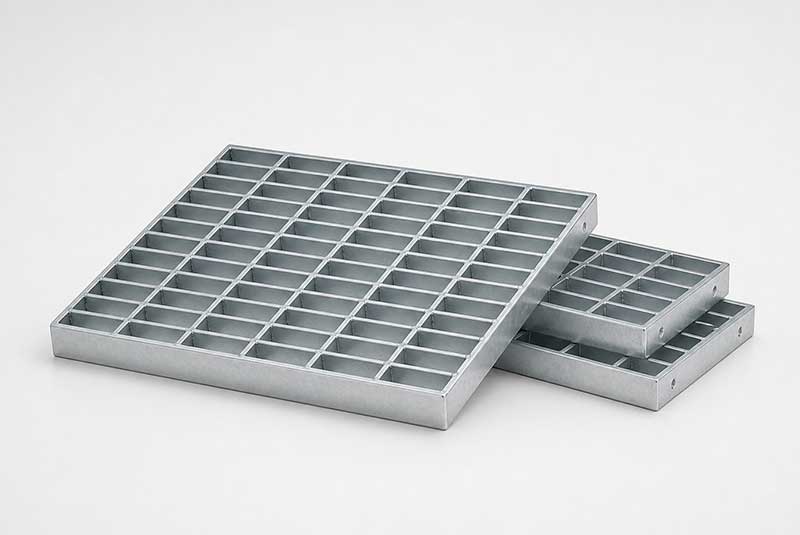
Bearing-bar pitch is the distance from one bar centre to the next. The clear opening is the space between the bar faces. Those dimensions are related but are not interchangeable. Cross-bar spacing describes the other grid direction and may use a different convention in a catalogue code. Identify all three dimensions on a section and plan view.
An opening requirement should apply to the completed product. Bar shape, serrations, welding, and finishing can affect the usable gap. Measure several openings on a representative piece rather than selecting the most convenient one. Where narrow wheels, small objects, or accessibility requirements drive the choice, state that purpose explicitly. The structural reviewer must still assess the bearing-bar section and span. A mesh code does not establish the complete panel capacity.

Map the actual wheel contact and route for 19w2 steel grating
When reviewing 19w2 steel grating, keep the actual wheel footprint and the manufacturer's matching construction data with the supplier response. This gives the technical discussion a specific acceptance reference.
Wheel diameter, tread width, material, and swivel behaviour influence how a grid is used. A narrow wheel may follow an opening, catch at a joint, or create a concentrated demand on only a few bearing bars. The route through a turn can differ from the route during straight travel.
Obtain the operating wheel loads and contact information from the equipment owner or manufacturer. Include the carried load and any relevant project allowance defined by the responsible designer. Show where the wheels cross the supports and the grid. A representative rolling assessment can help evaluate usability, but it does not replace a structural assessment. Keep these two questions separate so that comfortable movement is not mistaken for proof of load capacity, or adequate strength for proof of a suitable wheel route.
Follow the bearing bars between their supports for 19w2 steel grating
For 19w2 steel grating, a change that affects cross-bar frequency and wheel contact should be declared before production. Review the effect on adjacent components and the installation sequence.
The principal bearing bars transfer load across the unsupported distance to the supporting members. Their direction should be visible on the layout, especially where square panels could be rotated during installation. Identify the actual seating surfaces and measure the relevant clear span using the convention of the proposed assessment.
Capacity information needs to match the material, bearing-bar section, construction, and loading basis. Uniformly distributed loads, concentrated loads, and wheel loads should not be treated as equivalent simply because they have the same total weight. Retain the notes and units that accompany a supplier's table. Where the support condition differs from the table, ask for a project-specific review. Connections and the surrounding frame are separate parts of the load path and should be included in the coordinated design.
A worked review scenario: workshop trolley routes
Consider a hypothetical enquiry for 19w2 steel grating in workshop trolley routes. The buyer receives two proposals that share a broad product description. Proposal A explicitly addresses cross-bar frequency and wheel contact and includes the actual wheel footprint and the manufacturer's matching construction data. Proposal B omits that evidence and assumes that the existing interface is acceptable. The example is an enquiry comparison, not a claim about an actual Senfa customer or a completed project.
The buyer should first resolve the missing information in Proposal B. A lower price does not answer whether the proposal prevents assuming closer cross bars automatically increase the published main-span capacity. Ask the supplier to identify its assumptions and show the completed assembly against the same released requirements. The two offers become comparable only when their interfaces, fabrication scope, and evidence are clear.
The decision record for 19w2 steel grating should name the accepted drawing and explain why the selected arrangement meets the defined duty. If the project cannot yet provide the actual wheel footprint and the manufacturer's matching construction data, keep the technical question open. The next useful step is a survey, sample, calculation, or coordinated drawing appropriate to that missing input; repeating a general capacity or quality claim will not close it.

Compare the available approaches: 19w2 steel grating
Use the table to structure a 19w2 steel grating discussion. It identifies different supply approaches rather than ranking products without project data. For this enquiry, carry cross-bar frequency and wheel contact through every column.
| Approach | When it may fit | Evidence to review |
|---|---|---|
| Stock panel used unchanged | Regular supports and no special interfaces | Confirm section, orientation, finish, and matching duty evidence |
| Drawing-based fabricated panel | Equipment openings or irregular bays | Approve the complete layout, special edges, and panel marks |
| Alternative construction or material | A defined operational requirement justifies a change | Review support, fixing, mass, exposure, and serviceability together |
For 19w2 steel grating, the comparison is complete only after declared deviations are resolved. Keep pricing, technical acceptance, and delivery responsibilities visible. A useful offer states what is supplied and what the buyer or site contractor still needs to provide.
Information to send with the enquiry: 19w2 steel grating
A 19w2 steel grating enquiry should include a location plan, dimensions with units, the intended duty, and the surrounding support or connection geometry. For workshop trolley routes, highlight cross-bar frequency and wheel contact rather than burying it in a general note. Attach the actual wheel footprint and the manufacturer's matching construction data where it is already available, or identify who will provide it before fabrication.
Include quantities by component mark, material and finish requirements, inspection documents, and the destination handling constraints. Define whether accessories, frames, special fabrication, packing, and site assembly are included. Ask the supplier to list any deviation against the released information. This prevents assuming closer cross bars automatically increase the published main-span capacity from remaining hidden as an assumption in the quotation.
Keep related terms such as custom steel grating, steel grating panels, industrial steel grating connected to the same duty brief when searching catalogues. Similar wording does not make different constructions interchangeable. For 19w2 steel grating, the approved physical definition and its acceptance evidence take precedence over a short catalogue description.
Acceptance and change control: 19w2 steel grating
Before releasing 19w2 steel grating for production, confirm that the drawing, component schedule, and supplier response describe the same revision. The review should explicitly close the question of cross-bar frequency and wheel contact. Record acceptance against the actual wheel footprint and the manufacturer's matching construction data and identify any remaining site-dependent checks.
At delivery, match the marks and quantities to the packing list and examine visible damage before the components are distributed. During installation, check the actual interface and the completed secured condition. The practical warning for this application remains assuming closer cross bars automatically increase the published main-span capacity. A correct-looking component should not be used to dismiss an unresolved interface or duty question.
Changes to the equipment, route, exposure, or support can invalidate earlier assumptions. Review them before modifying a finished part. Preserve the final drawing and records for future 19w2 steel grating replacement so that the next order begins with the accepted installation rather than a new guess.
Reference and related Senfa resources: 19w2 steel grating
For applicable US workplaces, OSHA addresses surface condition, intended loads, access, and inspection. Use the governing project rules for the actual installation. This reference is background guidance and does not establish product certification. See the OSHA walking-working surface requirements.
For the relevant product family, review Senfa steel grating and the platform steel grating product page. Use drawing-based fabrication and finishing support to discuss the specific interface, and technical support resources for the broader product context.
Discuss the project with Senfa: 19w2 steel grating
To discuss 19w2 steel grating, send the released drawing or a labelled survey, the quantity schedule, and the operating requirements for workshop trolley routes. Highlight cross-bar frequency and wheel contact and include the actual wheel footprint and the manufacturer's matching construction data when available. Senfa lists drawing review, secondary fabrication, surface-treatment options, and technical project support among its services.
Request a proposal that identifies the construction, interfaces, supplied accessories, finishing, inspection records, and delivery scope. Ask for deviations to be stated clearly so the project team can review them before ordering 19w2 steel grating. The enquiry form below provides a starting point for that discussion; final selection should follow the approved project information.
Frequently asked questions
How should spacing be recorded for 19w2 steel grating?
Record bearing-bar centres, clear openings, cross-bar centres, and the orientation of the grid. State whether measurements apply before or after finishing. Keep a supplier-confirmed designation legend with the drawing so a later replacement can be specified from physical dimensions.
Which wheel data help the supplier for 19w2 steel grating?
Provide wheel load, contact dimensions, diameter, tread material, and travel or turning direction. Identify joints and support positions. The structural assessment and any usability trial should use the proposed grid and the actual operating route.
Can a catalogue span table be used directly for 19w2 steel grating?
Only after its construction, support convention, material, load case, and acceptance limits have been checked against the project. Keep the complete table and notes. A table for another bar section or a different support arrangement is not interchangeable evidence.
What is the main decision in this 19w2 steel grating enquiry?
The central decision is cross-bar frequency and wheel contact for workshop trolley routes. Request the actual wheel footprint and the manufacturer's matching construction data and use the same released information when comparing proposals. This keeps the discussion connected to the installed duty.
What should be avoided when ordering 19w2 steel grating?
Avoid assuming closer cross bars automatically increase the published main-span capacity. Resolve the relevant interface and acceptance evidence before fabrication, declare any supplier assumptions, and review later changes against the approved arrangement rather than relying on visual similarity.