Table of Contents
Introduction
Aluminum grating is an open-grid flooring and access material used for platforms, walkways, stair treads, drainage covers, ventilation areas, and equipment access systems. Its main advantage is not simply that it is lightweight. Its real value appears when reduced structural weight, corrosion resistance, easier handling, and an open walking surface are required at the same time.
Because aluminum has a substantially lower density than steel and naturally develops a thin oxide layer when exposed to air, it can perform well in many weight-sensitive and moderately corrosive environments. However, its stiffness, wear behavior, thermal movement, fastening requirements, and compatibility with surrounding metals must still be evaluated carefully.
This article explains:
- How aluminum grating is constructed
- Which manufacturing types are commonly available
- How it compares with carbon steel and stainless steel grating
- What determines load capacity and deflection
- Where aluminum panels perform best
- How to select spacing, surface profile, finish, and fasteners
- Which installation mistakes may shorten service life
- When another grating material may be more suitable
The objective is not to present aluminum as a universal replacement for steel. It is to help you identify the applications in which aluminum grating offers a practical engineering advantage.
What Is Aluminum Grating?
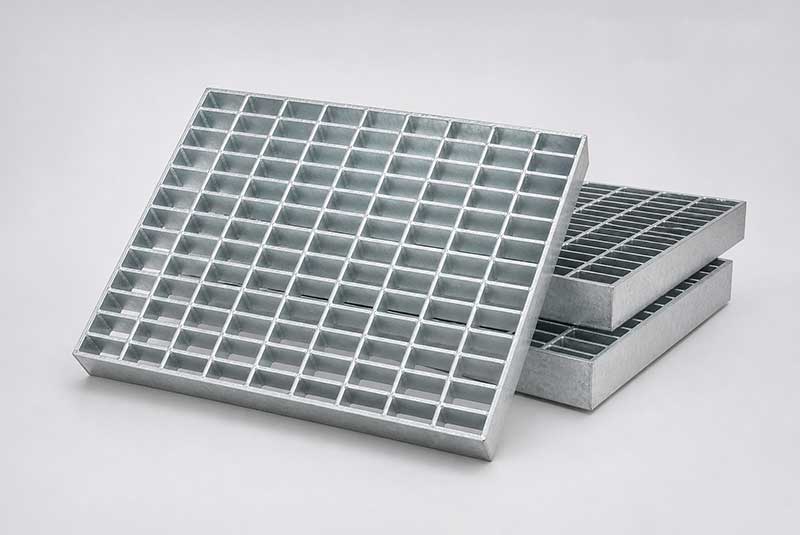
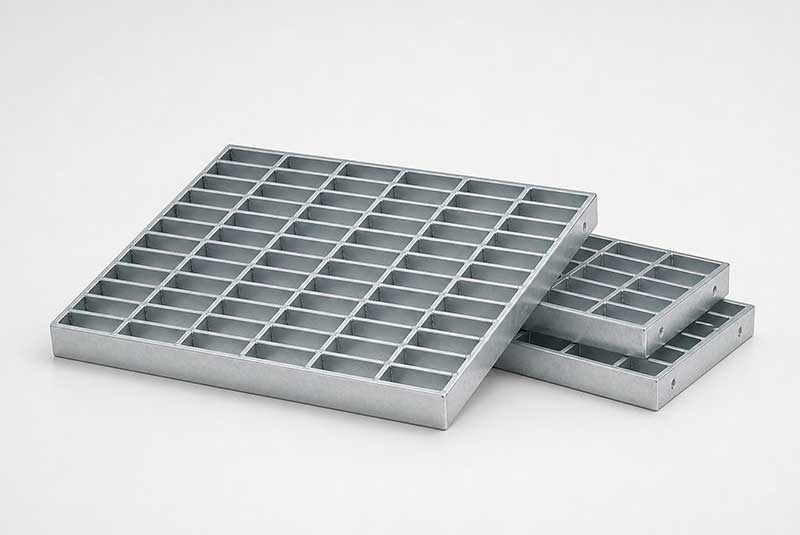
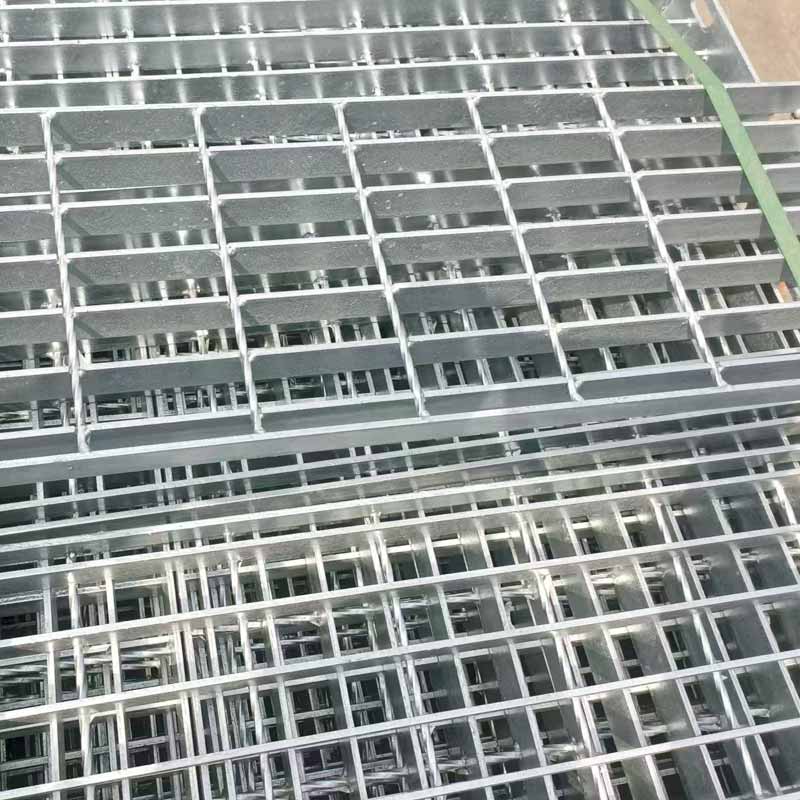
Aluminum grating is an open-grid panel formed from parallel load-carrying bars connected by cross members. The bearing bars span between structural supports, while the cross members maintain spacing and stabilize the panel.
This structural principle is similar to other bar grating systems. The bearing bars carry most of the applied load, so their direction, depth, thickness, spacing, alloy, and unsupported span have a direct effect on panel performance. A general platform grating structure also relies on bearing bars running in one direction and cross bars connecting them at regular intervals.
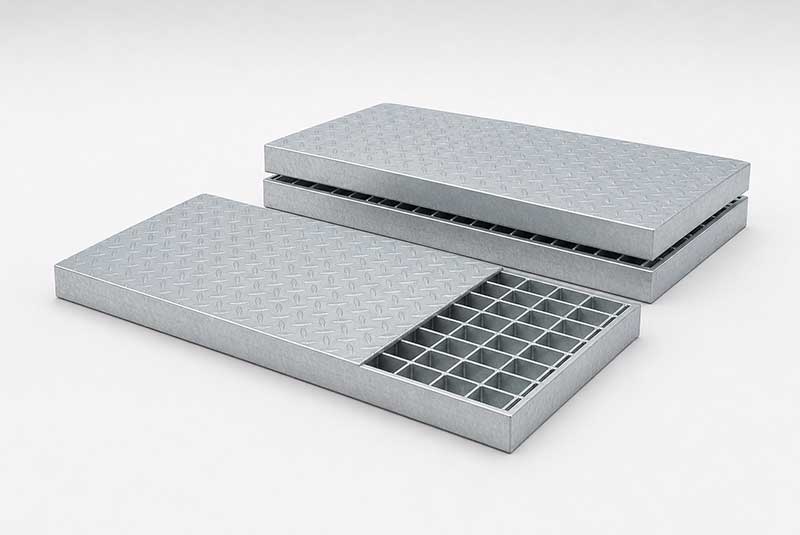
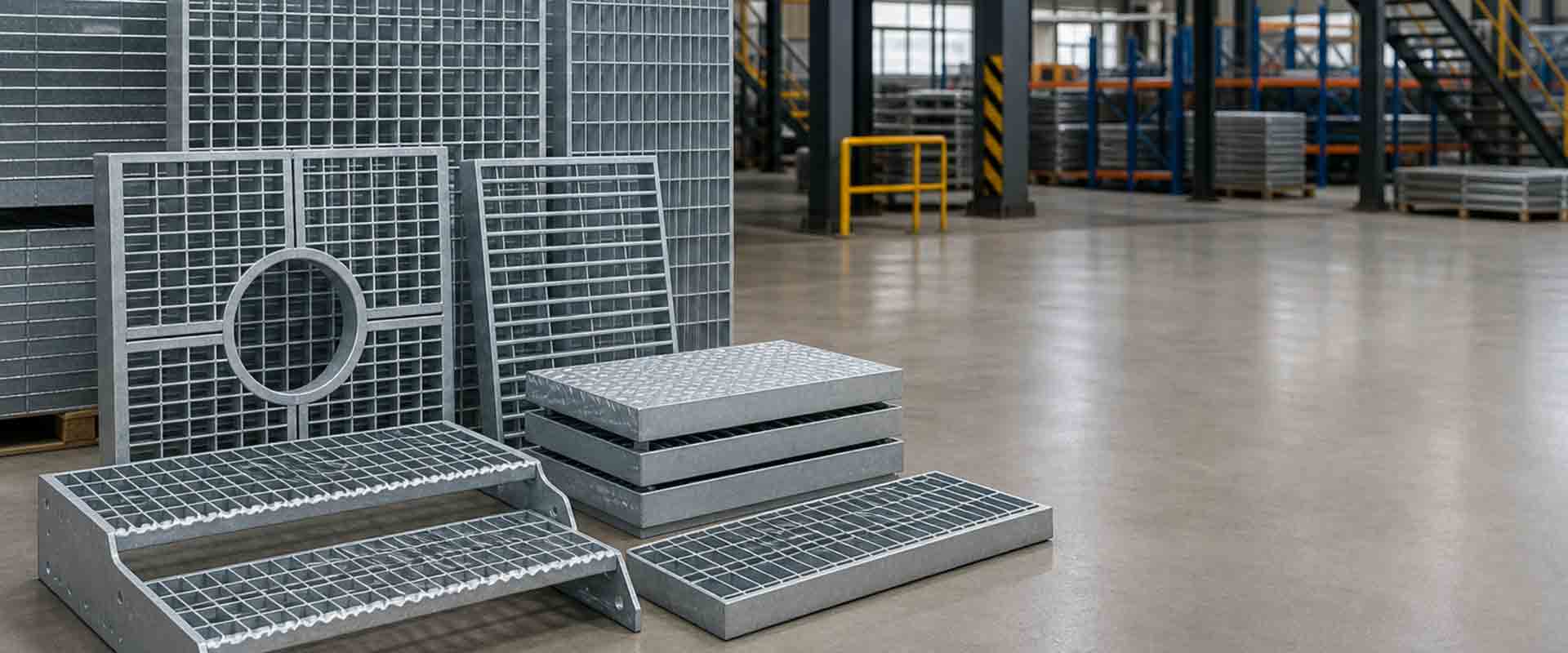
Aluminum grating may be supplied as rectangular panels or fabricated into project-specific shapes. Depending on the application, finished panels may include:
- Banded edges
- Pipe openings
- Equipment cutouts
- Toe plates
- Stair-tread side plates
- Nosing
- Removable access sections
- Mechanical fixing points
- Identification marks
The open-grid structure allows air, light, water, dust, and small debris to pass through the surface. This makes it useful where solid flooring would create unnecessary weight or allow liquids to collect.
Bearing bars
Bearing bars are the main structural members. They extend from one support to another and resist bending under pedestrian, equipment, cart, or maintenance loads.
Bar depth is especially important because increasing depth generally improves resistance to bending. Bar thickness also affects strength, durability, and the ability to resist concentrated loading.
Cross members
Cross members hold the bearing bars in position and help stabilize the panel. Depending on the manufacturing design, they may be mechanically locked, swaged, pressed, riveted, or otherwise connected.
They should not normally be treated as substitutes for the primary bearing bars. Correct panel orientation is therefore essential during installation.
Open area
Open area describes the proportion of space between the bars. A larger open area can improve drainage, airflow, light transmission, and debris passage.
The largest opening is not automatically the best choice. Opening size should also reflect footwear, wheel dimensions, object-retention needs, walking comfort, and the risk of small tools or components falling through the surface.
How Aluminum Grating Is Manufactured
The manufacturing method influences panel stiffness, appearance, dimensional consistency, connection stability, and suitability for different operating conditions.
Swage-locked aluminum grating
Swage-locked grating is produced by inserting cross rods through bearing bars and mechanically deforming or locking the rods in position.
This process creates a stable grid without relying on conventional welded intersections. It is commonly associated with lightweight industrial flooring, walkways, platforms, and access systems.
The finished panel can provide:
- Consistent bar spacing
- A relatively clean appearance
- Good panel stability
- Efficient fabrication
- Multiple spacing configurations
Press-locked aluminum grating
Press-locked grating is formed by applying controlled pressure to interlock the cross members and bearing bars.
The resulting grid often has precise spacing and a uniform visual pattern. It may be selected for industrial access systems as well as visible architectural or ventilation applications.
Riveted aluminum grating
Riveted designs use connecting members and mechanical fasteners to join the bearing bars.
This structure may be considered where repeated movement, rolling traffic, or a specific panel configuration requires a mechanically connected design. Its suitability depends on the complete load condition rather than the presence of rivets alone.
Aluminum plank grating
Plank grating is formed from aluminum sheet or extruded sections rather than separate rectangular bearing bars.
The surface may include perforations, raised patterns, drainage openings, or serrated features. It is often used for stairs, ramps, service access, and locations where a more continuous walking surface is preferred.
Custom fabricated panels
Standard panels can be cut and banded to match a project layout. More complex panels may be fabricated with curved boundaries, penetrations, removable sections, or equipment clearances.
Factory-planned fabrication is generally more controlled than extensive field cutting because the manufacturer can account for edge reinforcement, bar continuity, fit, and fastening locations before production.
Main Types of Aluminum Grating
Aluminum grating can be classified by structural design, surface profile, duty level, and intended application.
Plain aluminum grating
Plain panels have relatively smooth upper bearing-bar surfaces. They are suitable for many dry platforms, walkways, screens, and access areas.
A plain surface can offer:
- Easier cleaning
- Comfortable pedestrian access
- Simple visual inspection
- Consistent appearance
It should still be reviewed against moisture, oil, slope, footwear, and housekeeping conditions.
Serrated aluminum grating
Serrated panels include notches or teeth along the walking surface. These features add contact points and can improve traction when the surface is exposed to moisture or process residue.
Serrated grating may be suitable for:
- Outdoor walkways
- Wet processing areas
- Maintenance platforms
- Drainage locations
- Access routes near machinery
Serrations are only one part of slip-risk control. Drainage, cleaning, lighting, footwear, handrails, and routine inspection remain important.
Close-mesh aluminum grating
Close-mesh grating uses narrower openings between bearing bars. It can provide better support for small wheels, narrow footwear, or areas where object retention matters.
Reducing the opening size may also change panel weight, airflow, drainage, and fabrication requirements. These effects should be reviewed together.
Heavy-duty aluminum grating
Heavy-duty panels use deeper, thicker, or more closely spaced bearing bars.
They may be designed for demanding pedestrian, cart, equipment, or maintenance loads. However, the term “heavy duty” is not a complete engineering specification. The actual bar dimensions, alloy, span, support arrangement, load contact area, and deflection limit must still be stated.
Architectural aluminum grating
Architectural grating is often selected when appearance, light control, ventilation, screening, or façade integration is important.
Its load requirements may be lower than those of industrial flooring, but wind, attachment, vibration, finish quality, thermal movement, and long-term appearance still require careful evaluation.
Aluminum Grating vs Steel Grating
Aluminum and steel grating may have similar open-grid forms, but they do not behave identically. A direct substitution based only on panel dimensions can create strength, deflection, installation, or durability problems.
| Selection factor | Aluminum grating | Carbon steel grating | Stainless steel grating |
|---|---|---|---|
| Relative weight | Low | Higher | Higher |
| Structural stiffness | Lower for comparable geometry | Higher | Higher |
| Natural corrosion behavior | Forms a protective oxide layer | Usually requires protective treatment in exposed conditions | Depends on alloy and environment |
| Handling | Easier for many removable panels | May require more lifting effort | May require more lifting effort |
| Magnetic behavior | Nonmagnetic | Usually magnetic | Depends on grade and processing |
| Thermal movement | Requires careful allowance | Lower dimensional change for the same temperature range | Lower than aluminum in many common grades |
| Galvanic compatibility | Requires attention near dissimilar metals | Requires coating and connection review | May accelerate attack of connected aluminum in some environments |
| Typical advantage | Low weight and easier handling | High stiffness and demanding load capacity | Corrosion resistance and hygiene |
| Typical limitation | Greater deflection and thermal movement | Higher weight and corrosion-protection needs | Higher weight and alloy-specific fabrication requirements |
Weight advantage
Aluminum is approximately one-third the density of steel. A lower-density panel can reduce dead load on the supporting structure and make removable sections easier to lift during maintenance.
The actual panel-weight difference depends on bar size and spacing. Aluminum sections may need different dimensions to achieve the required stiffness, so material density should not be treated as the only comparison factor.
Stiffness difference
Aluminum is less stiff than steel. Two panels with identical bar dimensions and spans will therefore not normally deflect by the same amount.
An aluminum panel may require deeper bars, closer spacing, shorter spans, or additional supports to meet the same serviceability target.
Corrosion behavior
Aluminum naturally forms an oxide layer that helps protect the underlying metal in many normal environments. However, dissolved salts, aggressive chemicals, crevices, and contact with dissimilar metals can disrupt this protection or accelerate localized corrosion.
Handling and maintenance
The lower panel weight can make installation and periodic removal easier. This is particularly useful for access covers, inspection panels, and areas where maintenance teams frequently open the flooring.
Handling advantages should not lead to reduced fastening. A lightweight panel can still lift, shift, or vibrate if it is inadequately secured.
What Determines Aluminum Grating Load Capacity?
Load capacity is determined by a system of connected variables. Panel appearance or outside dimensions alone cannot confirm whether a grating is suitable.
Alloy and temper
Different aluminum alloys and tempers have different strength, ductility, corrosion, and fabrication characteristics.
The specification should identify the required alloy and temper rather than state only “aluminum.” Substituting another grade without reviewing its properties may affect load capacity, weldability, corrosion resistance, and long-term performance.
Bearing-bar depth
Deeper bearing bars generally resist bending more effectively over a given span.
Where deflection controls the design, increasing bar depth or reducing the unsupported span may be more effective than making a small change in bar thickness.
Bearing-bar thickness
Thickness contributes to strength, local load resistance, wear life, and durability around connections or cutouts.
A thicker bar may be appropriate where wheels, equipment legs, repeated traffic, or mechanical impact create concentrated forces.
Bar spacing
Closer bearing-bar spacing places more bars under the applied load. It may improve support for narrow wheels and reduce the clear opening between bars.
Wider spacing can increase open area and reduce panel weight, but it may not support every pedestrian or equipment application.
Clear span
Clear span is the unsupported distance between structural supports. It is one of the most influential design variables.
A modest increase in span can produce a noticeable increase in deflection. The support layout should therefore be confirmed before panel dimensions are finalized.
Load contact area
A uniformly distributed load and a concentrated wheel load do not act in the same way.
Equipment legs, carts, narrow wheels, and temporary maintenance devices may place most of their force on only a few bearing bars. The contact area and direction of travel should be included in the load review.
Deflection
A panel may remain below its structural strength limit but still flex more than the project permits.
Excessive movement can affect:
- Walking comfort
- Equipment stability
- Fastener performance
- Panel alignment
- Joint quality
- User confidence
- Vibration and noise
Both strength and serviceability should therefore be evaluated.
Key Advantages of Aluminum Grating
The benefits of aluminum grating are most valuable when they solve a defined project problem.
Reduced structural dead load
Lower panel weight can reduce the permanent load carried by platforms, frames, roof structures, service modules, and access systems.
This can be particularly useful in retrofit work where the existing structure has limited capacity for additional dead load.
Easier panel handling
Maintenance teams may need to remove access panels to inspect equipment, pipes, channels, or utilities below the floor.
A lighter panel can simplify lifting, repositioning, and replacement. Proper lifting points and safe manual-handling limits must still be considered.
Natural surface protection
The oxide layer that develops on aluminum provides useful protection in many atmospheric conditions.
This does not mean the material is corrosion-proof. The alloy, exposure, deposits, cleaning chemicals, crevices, and nearby metals remain important.
Nonmagnetic material
Aluminum is nonmagnetic, which may benefit applications where magnetic behavior could interfere with equipment or processes.
The entire assembly must be reviewed because fasteners, support frames, and accessories may still contain magnetic materials.
Good drainage and ventilation
Like other open-grid systems, aluminum panels allow liquids, air, heat, light, and debris to pass through.
This can reduce standing water and improve airflow, provided the surrounding structure does not block drainage.
Fabrication flexibility
Aluminum can be cut, drilled, machined, and formed into project-specific panels.
Fabrication must account for alloy characteristics, edge quality, heat effects, distortion, and the need to protect finished surfaces.
Common Applications of Aluminum Grating
Maintenance platforms
Aluminum grating is suitable for elevated access areas where low dead load and corrosion performance are important.
The open-grid surface can also make equipment below the platform easier to inspect.
Walkways and catwalks
Walkways around tanks, machinery, conveyors, ducts, piping, and utility systems may benefit from lightweight removable panels.
The same design factors used for other industrial grating systems—bearing direction, spacing, dimensions, cutouts, and surface treatment—can be reviewed through Senfa’s industrial grating product range. The site presents platform, walkway, stair, drainage, equipment-access, and custom fabrication categories.
Stair treads
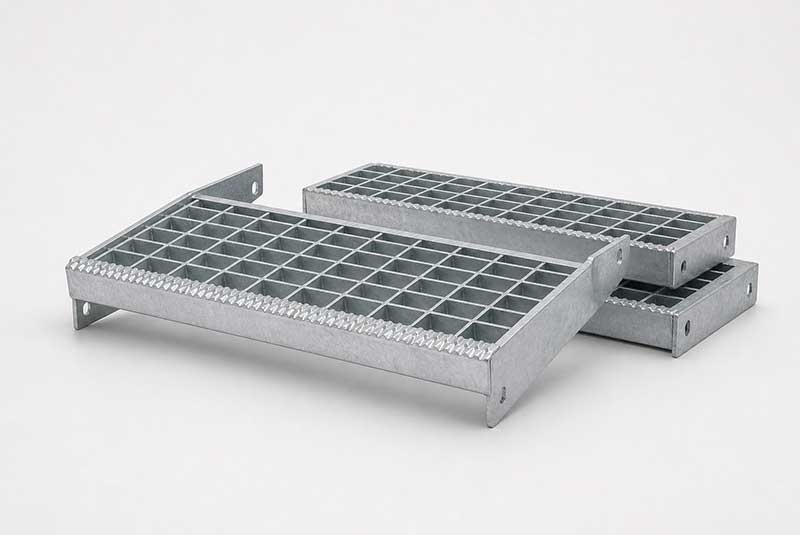
Aluminum stair treads may include serrated bearing bars, side plates, mounting holes, and contrasting or reinforced nosing.
Tread depth, walking surface, support, fasteners, and edge details should be coordinated with the entire stair system.
Drainage covers
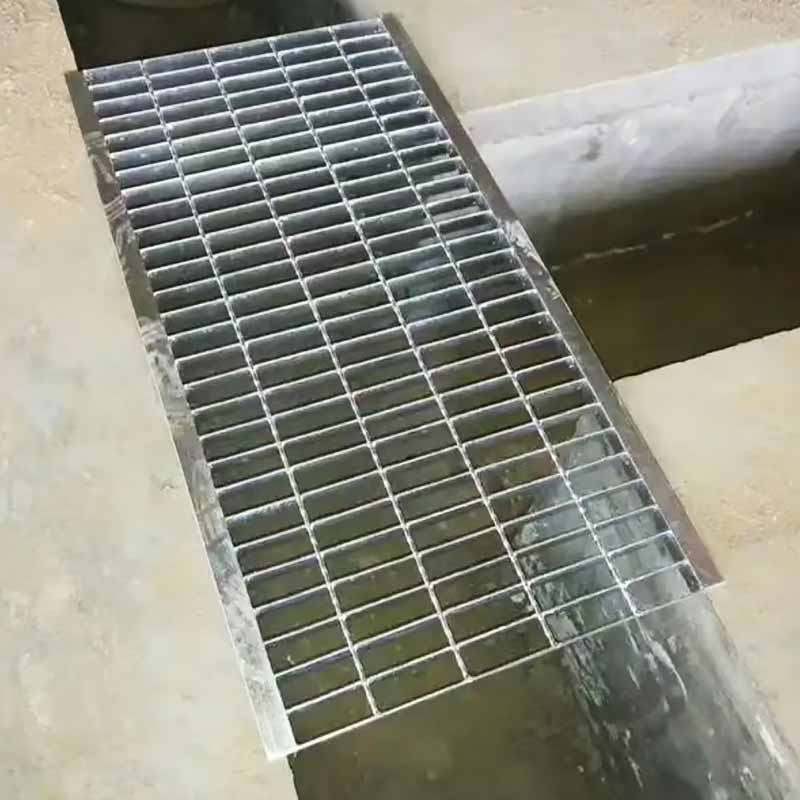
The open grid permits water to enter a channel while maintaining access across the opening.
Removable covers require adequate support, stable seating, appropriate openings, and secure fastening to prevent rocking or displacement.
Ventilation screens
Aluminum panels can be used for ventilation openings, mechanical screens, shading systems, and equipment enclosures.
In these applications, airflow, appearance, vibration, attachment, and thermal movement may be more important than floor-loading capacity.
Roof and elevated access
Low-weight panels can be useful for access routes installed on roofs or lightweight supporting structures.
The design must consider wind uplift, panel anchorage, support spacing, temperature changes, and the effect of concentrated maintenance loads.
Utility and service access
Removable sections can provide access to pipes, cables, filters, valves, and inspection points.
Panel labels or identification marks help ensure that each custom section is returned to its intended location.
Corrosion, Anodizing, and Surface Finishes
Natural oxide layer
When exposed to oxygen, aluminum forms a very thin oxide film that limits further reaction in many ordinary conditions.
The film can reform after minor surface damage, but its protective performance depends on the alloy and surrounding environment. Chlorides, high or low pH conditions, trapped moisture, and contact with incompatible metals can increase corrosion risk.
Mill finish
Mill-finish grating is supplied without an added decorative or anodized finish.
Its appearance may vary, and handling marks or natural oxidation may become visible over time. It can be appropriate where appearance is secondary and the operating environment is compatible with the selected alloy.
Anodized finish
Anodizing increases the thickness of the aluminum oxide layer. It can improve surface durability, corrosion resistance, appearance, and coating adhesion.
Anodizing does not increase the structural strength of the grating itself. The underlying alloy, section dimensions, and support conditions continue to control load capacity.
Protective coating
A compatible coating may be applied where a particular color, appearance, or exposure requirement must be met.
Surface preparation, pretreatment, coating thickness, curing, edge coverage, and installation damage all affect long-term performance.
Galvanic corrosion
Galvanic corrosion can occur when aluminum contacts a more noble metal in the presence of an electrolyte such as contaminated water.
Risk control may involve:
- Electrically isolating dissimilar metals
- Using compatible fasteners
- Applying protective coatings
- Preventing trapped moisture
- Providing drainage
- Avoiding small aluminum areas connected to large noble-metal surfaces
- Maintaining damaged interfaces
Material compatibility should be reviewed as part of the complete assembly, not only at the grating panel.
How to Select Aluminum Grating
A practical selection process can be organized into four review paths: structural performance, environmental exposure, user interaction, and installation detail.
Structural performance
Begin with the actual support and loading conditions.
Confirm:
- Clear support span
- Bearing-bar direction
- Distributed loads
- Concentrated loads
- Wheel contact area
- Impact or vibration
- Allowable deflection
- Required safety factors
Do not select a panel from dimensions alone. Load tables are useful only when the panel alloy, bar size, spacing, span, support, and loading conditions match the table assumptions.
Environmental exposure
Identify the substances and conditions that may contact the grating.
Review:
- Water
- Dissolved salts
- Process chemicals
- Cleaning agents
- Temperature
- Abrasion
- Outdoor exposure
- Deposits and debris
- Contact with dissimilar metals
A general statement such as “corrosion-resistant environment” is not detailed enough for material selection.
User interaction
Consider how people and equipment will move over the surface.
Questions should include:
- Will the grating support pedestrians only?
- Are carts or narrow wheels involved?
- Could small tools fall through the openings?
- Is the surface likely to become wet?
- Will users wear specialized footwear?
- Are accessibility requirements involved?
- Does the platform require frequent panel removal?
The opening pattern and surface profile should reflect these conditions.
Installation detail
Confirm how the panels will be supported, fixed, aligned, and removed.
The installation design should address:
- Minimum bearing area
- Panel joints
- Fastener type
- Dissimilar-metal isolation
- Wind uplift
- Vibration
- Thermal movement
- Removable sections
- Coating or anodizing damage
- Drainage around supports
Aluminum Grating Specification Checklist
A complete request for aluminum grating should include enough information for the manufacturer to understand both the panel and its service conditions.
Product type
State whether the panel is swage-locked, press-locked, riveted, plank-style, serrated, close-mesh, or another design.
Alloy and temper
Identify the required material grade and condition.
Where the exact alloy has not yet been selected, provide the load, corrosion, fabrication, and finish requirements so the choice can be reviewed technically.
Bearing-bar dimensions
Specify bar depth and thickness.
These dimensions should correspond with the load table or engineering calculation used for the project.
Bearing-bar spacing
State the center-to-center spacing or required clear opening.
Spacing must suit the load, wheels, footwear, drainage, and object-retention requirements.
Cross-member spacing
Cross-member spacing affects grid geometry, stability, and appearance.
It should be included in both drawings and technical schedules.
Panel dimensions
Provide finished length and width together with the bearing-bar direction.
The longest side is not automatically the structural span.
Support span
State the clear distance between supports.
Do not substitute overall panel length for unsupported span.
Surface profile
Identify whether the surface should be plain, serrated, perforated, or another profile.
Surface finish
Specify mill finish, anodizing, coating, or another approved treatment.
Cutouts and openings
Show all columns, pipes, equipment bases, access hatches, valves, and irregular boundaries on coordinated drawings.
Fastening
State whether the grating will be clipped, bolted, mechanically locked, welded through approved procedures, or fastened using another method.
Senfa’s platform grating configurations demonstrate how grating schedules commonly organize bearing-bar dimensions, cross-bar dimensions, spacing, width, and panel length. These specification fields remain useful when preparing an aluminum grating inquiry, even though the final values must be verified for the selected material.
Installation Best Practices
Verify the support structure
Supports should be level, aligned, clean, and capable of providing sufficient bearing area.
Uneven or distorted supports can make panels rock and can concentrate loads near edges.
Confirm bearing-bar direction
Bearing bars must span from one structural support to another.
Installing the panel with cross members spanning the opening can substantially reduce effective performance.
Isolate dissimilar metals
Where aluminum contacts carbon steel, stainless steel, copper-bearing materials, or other dissimilar metals, assess galvanic compatibility.
Isolation pads, sleeves, washers, coatings, and drainage details may be required.
Allow for thermal movement
Aluminum expands and contracts with temperature changes.
Large panels, long walkways, exterior installations, and rigid attachments should be detailed so movement does not cause buckling, fastener stress, noise, or joint misalignment.
Secure the panels
Lightweight panels still require reliable fastening.
Clips, bolts, hold-down devices, or engineered attachments should resist movement, vibration, uplift, and accidental displacement while allowing planned maintenance access.
Protect finished surfaces
Anodized or coated panels should be handled using methods that reduce scratching, impact, contamination, and abrasion.
Damaged finishes should be evaluated and repaired with a compatible system where necessary.
Inspection and Maintenance
Aluminum grating is often described as low maintenance, but it is not inspection-free.
The inspection program should reflect traffic, exposure, vibration, contamination, panel removal, and previous damage.
Structural inspection
Check for:
- Bent bearing bars
- Damaged cross connections
- Distorted banding
- Cracks near cutouts
- Excessive movement
- Permanent deflection
- Impact damage
- Unsupported modifications
Fastener inspection
Look for loose, missing, damaged, or incompatible fasteners.
Movement marks around clips or bolt holes may indicate vibration, insufficient tightening, thermal restraint, or poor support alignment.
Corrosion inspection
Inspect crevices, fastener interfaces, drainage points, and areas where different metals meet.
White corrosion products, pitting, staining, blistered coatings, or material loss may indicate that the environment or connection detail requires attention.
Surface inspection
Oil, mud, deposits, or process residue can reduce traction even on serrated surfaces.
Cleaning methods should be compatible with the alloy, anodizing, coating, and surrounding materials.
Support inspection
A sound aluminum panel can still become unsafe if its support frame corrodes, distorts, or loses bearing area.
The panel and the supporting structure should therefore be inspected as one system.
Common Aluminum Grating Selection Mistakes
Assuming low weight means low strength
Lightweight does not automatically mean weak, but it also does not confirm adequate capacity.
The section geometry, alloy, span, spacing, and load condition determine performance.
Copying a steel specification
Replacing steel grating with an aluminum panel of identical dimensions may result in greater deflection.
Material substitution should include a new structural and serviceability review.
Ignoring alloy designation
Different alloys may have different strength, corrosion behavior, weldability, and finishing characteristics.
A specification that states only “aluminum grating” leaves an important technical question unresolved.
Overlooking galvanic contact
Direct contact with dissimilar metals can create localized corrosion when moisture is present.
Fasteners, support frames, washers, clips, and nearby equipment should all be included in the compatibility review.
Using insufficient support
Long spans can produce uncomfortable movement even when the panel does not fail.
Additional support or deeper bearing bars may be necessary to control deflection.
Forgetting thermal expansion
Rigidly restraining long exterior runs can create joint, fastener, or alignment problems as temperature changes.
Treating serrations as complete slip protection
A serrated surface cannot compensate for poor drainage, accumulated oil, inadequate lighting, unsuitable footwear, or missing handrails.
Relying on uncontrolled field cutting
Field cutting may remove banding, reduce bar continuity, expose sharp edges, damage finishes, and create unsupported openings.
When Aluminum Grating May Not Be the Best Choice
Aluminum is advantageous in many projects, but another material may be more suitable when the operating conditions conflict with its properties.
Very high concentrated loads
Where extremely high wheel loads, impact, or machinery loads occur, steel grating may provide the required stiffness with more compact sections.
Aluminum can still be engineered for demanding loads, but bar dimensions, support spacing, and deflection may make another material more practical.
Severe abrasion
Repeated scraping, dragged equipment, sharp debris, or abrasive process materials can wear aluminum surfaces.
The expected wear mechanism should be reviewed before selection.
High-temperature exposure
Elevated temperature can reduce the mechanical strength of aluminum alloys.
The maximum operating temperature, duration, and load should be evaluated using material data appropriate to the selected alloy and temper.
Strong chemical exposure
Certain alkaline conditions, chlorides, mercury-containing contamination, and other aggressive substances can attack aluminum or disrupt its protective surface layer.
Uncontrolled dissimilar-metal contact
Where electrical isolation and drainage cannot be maintained, galvanic corrosion may make the connection difficult to manage reliably.
Future Development of Aluminum Grating
Aluminum grating is likely to develop through better digital coordination, more detailed performance specifications, improved connection design, and closer integration with modular structures.
Digital panel mapping
Three-dimensional models can coordinate supports, openings, panel boundaries, fastening points, and installation sequences before fabrication.
This reduces field cutting and helps avoid unsupported edges.
Performance-based specifications
Projects are increasingly evaluated around actual load paths, deflection, environmental exposure, user needs, and lifecycle maintenance rather than standard panel dimensions alone.
Improved removable-panel systems
Lighter access panels can be combined with identification marks, captive fasteners, lifting provisions, and controlled support details.
This improves maintenance access while reducing the risk of panels being returned to the wrong location.
Better material compatibility planning
Digital schedules can identify fastener materials, isolation components, coatings, and contact interfaces before installation.
This helps reduce galvanic corrosion risk and inconsistent site substitutions.
Lifecycle-focused design
Future specifications will increasingly consider inspection access, cleaning, panel removal, finish repair, component replacement, and recyclability alongside initial structural performance.
Conclusion
Aluminum grating is a strong candidate for projects that require an open walking surface, lower structural weight, easier handling, drainage, ventilation, and useful atmospheric corrosion resistance.
Its benefits are greatest when the complete system is designed for aluminum rather than copied from a steel specification.
A reliable selection should define:
- Product construction
- Alloy and temper
- Bearing-bar size
- Bearing-bar spacing
- Cross-member spacing
- Clear support span
- Load distribution
- Allowable deflection
- Surface profile
- Surface finish
- Panel dimensions
- Cutouts and banding
- Fastening method
- Dissimilar-metal isolation
- Thermal-movement requirements
When these factors are coordinated before fabrication, aluminum grating can provide a lightweight, durable, and maintainable solution for industrial platforms, walkways, stairs, drainage covers, ventilation systems, and service-access structures.
FAQ
What is aluminum grating commonly used for?
Aluminum grating is commonly used for platforms, walkways, stair treads, drainage covers, ventilation screens, roof access, and removable maintenance panels. It is especially useful where low weight, drainage, corrosion performance, and easier handling are priorities.
How is aluminum grating load capacity determined?
Capacity depends on alloy, temper, bearing-bar depth and thickness, bar spacing, clear span, support conditions, and load contact area. Distributed pedestrian loads and concentrated wheel loads must be evaluated separately, along with allowable deflection.
Is aluminum grating suitable for outdoor use?
Yes, aluminum grating can perform well outdoors because it naturally forms a protective oxide layer. However, dissolved salts, trapped moisture, incompatible fasteners, chemical exposure, and galvanic contact must be considered in the material and connection design.
Is serrated aluminum grating always safer?
Serrated surfaces can improve traction in wet or contaminated areas, but they do not eliminate slipping. Safe performance also depends on drainage, cleaning, footwear, lighting, stable fastening, handrails, and regular inspection of the complete access system.
Can aluminum grating replace steel grating directly?
Not usually without review. Aluminum is lighter but less stiff than steel, so identical bar dimensions may produce greater deflection. Any substitution should reassess span, bar depth, spacing, alloy, concentrated loads, support conditions, fasteners, and thermal movement.