Table of Contents
Introduction
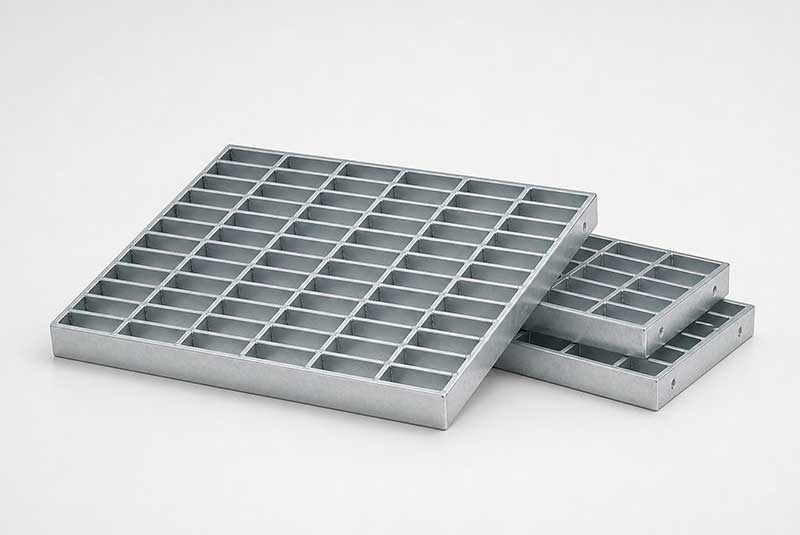
Steel grating and steel bar grating are common terms in industrial flooring, access platforms, drainage systems, stairways, and maintenance structures. Although people often use the two expressions interchangeably, they do not always describe exactly the same scope of products.
Steel grating is a broad category covering open-grid panels made from steel components. Steel bar grating is a specific form of steel grating constructed from parallel bearing bars connected by cross bars. The distinction matters because the bearing-bar arrangement directly affects load capacity, span, weight, drainage, slip resistance, and installation performance.
For engineers, contractors, facility managers, and purchasing teams, understanding these terms helps prevent specification errors. It also makes it easier to compare manufacturing methods, choose suitable surface treatments, and communicate technical requirements clearly.
This guide explains:
- The relationship between steel grating and steel bar grating
- The structural role of bearing bars and cross bars
- Common manufacturing methods and product types
- Load, span, spacing, and surface considerations
- Typical industrial applications
- Frequent selection and installation mistakes
Understanding Steel Grating and Steel Bar Grating
What is steel grating?
Steel grating is a general term for an open-grid panel manufactured from steel. It normally contains parallel load-supporting elements joined by perpendicular or angled connecting members.
The open construction allows water, air, light, small debris, and process materials to pass through the surface. This makes steel grating useful in locations where solid flooring could collect liquids, obstruct ventilation, or add unnecessary structural weight.
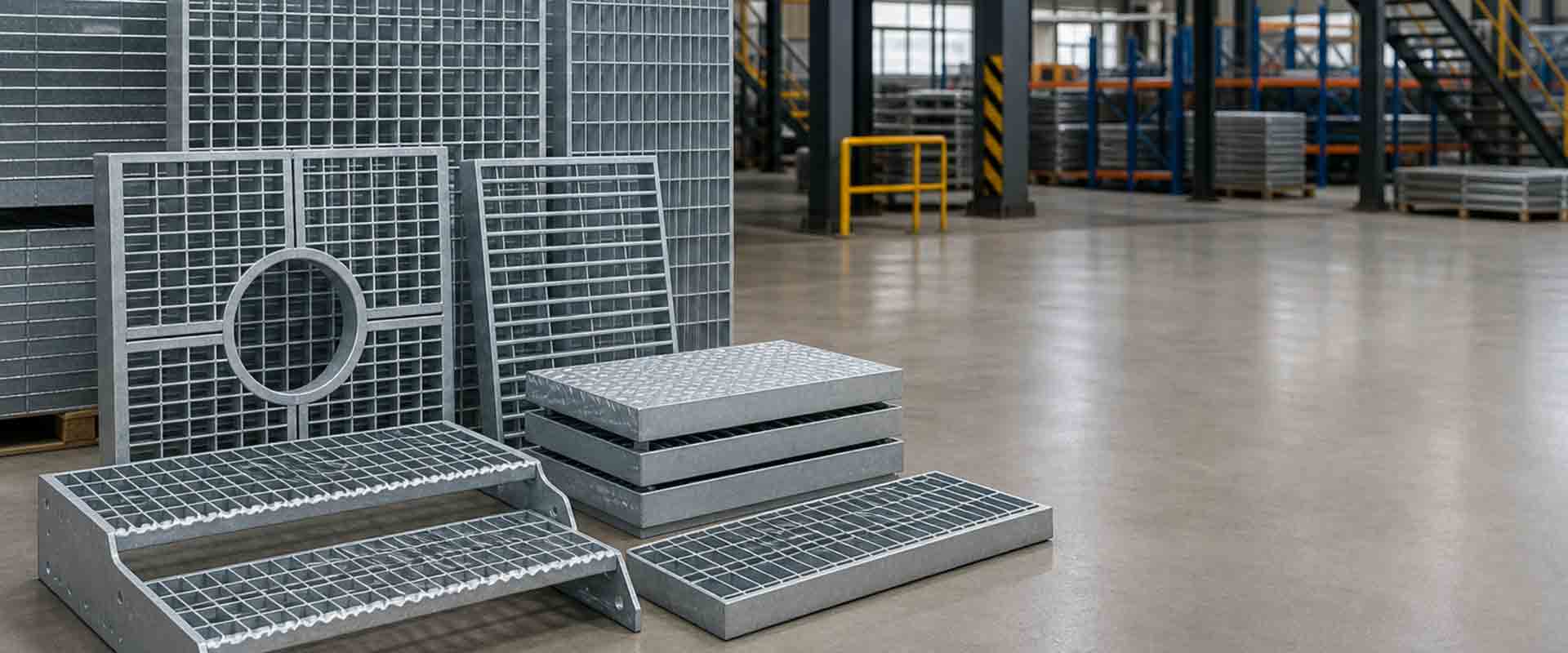
The term may refer to several designs, including welded grating, press-locked grating, riveted grating, heavy-duty grating, and other fabricated grid systems.
What is steel bar grating?
Steel bar grating is a defined type of steel grating made from load-carrying bearing bars and connecting cross bars. The bearing bars run between structural supports and carry most of the applied load.
Cross bars hold the bearing bars at the required spacing, improve panel stability, and help distribute concentrated forces. Edge banding may also be added around openings, cutouts, or exposed panel ends.
A typical steel bar grating specification considers:
- Bearing-bar depth and thickness
- Bearing-bar spacing
- Cross-bar spacing
- Clear span between supports
- Material grade
- Surface profile
- Surface treatment
- Panel dimensions
- Required load performance
Senfa Grating’s steel grating product range includes solutions for platforms, walkways, stair treads, drainage covers, and other industrial access applications.
Why the Terminology Difference Matters
The distinction is mainly about category and construction.
Steel grating describes the overall family of open steel grid products. Steel bar grating describes a particular structural system within that family.
This difference becomes important when a project requires engineering calculations. A general request for “steel grating” may not provide enough information for a manufacturer to determine the correct bearing-bar size, spacing, panel span, fastening method, or surface treatment.
Using the more specific term steel bar grating helps clarify that the required panel must be designed around load-bearing bars rather than selected only by appearance or overall dimensions.
Clear terminology also reduces the risk of:
- Ordering an unsuitable grating type
- Installing bearing bars in the wrong direction
- Selecting insufficient bar depth
- Using spacing that does not suit the application
- Overlooking slip-resistance requirements
- Misunderstanding the supporting span
Structural Differences Between Steel Grating and Steel Bar Grating
Bearing bars
Bearing bars are the primary structural members in steel bar grating. They extend from one support to another and resist bending under pedestrian, equipment, maintenance, or vehicle loads.
Their depth, thickness, spacing, material, and unsupported span all influence panel performance. Increasing bar depth generally improves bending resistance more effectively than increasing thickness alone, although the final design must be based on the complete load condition.
Cross bars
Cross bars connect the bearing bars and maintain consistent spacing. Depending on the manufacturing method, they may be welded, pressure-locked, swaged, or mechanically connected.
Cross bars contribute to panel stability, but they should not normally be treated as the primary load-bearing elements. This is why the direction of the bearing bars must be identified correctly before installation.
Edge banding
Banding bars may be attached to the perimeter of the panel. They create a finished edge, reinforce cut sections, and help protect exposed bearing-bar ends.
Banding is particularly useful around pipe penetrations, equipment bases, columns, access openings, and irregular panel shapes.
Open area
The spaces between the bars determine the grating’s open area. A larger open area can improve drainage, ventilation, light transmission, and material passage.
However, opening size must also be considered in relation to walking comfort, object retention, footwear, wheel size, safety requirements, and the operating environment.
Steel Grating vs Steel Bar Grating Comparison
| Comparison factor | Steel grating | Steel bar grating |
|---|---|---|
| Definition | Broad category of open steel grid products | Specific grating made from bearing bars and cross bars |
| Structural focus | Varies by product design | Based on the strength and spacing of bearing bars |
| Load design | Depends on the selected grating type | Calculated using bar size, spacing, span, and material |
| Manufacturing options | Welded, locked, riveted, or fabricated | Commonly welded or press-locked |
| Typical uses | Flooring, ventilation, screens, platforms, and covers | Industrial platforms, walkways, stairs, and trench covers |
| Customization | Depends on design | Can be adapted to drawings, openings, loads, and dimensions |
| Bearing direction | May vary by construction | Must run between supporting members |
| Surface options | Plain, serrated, coated, or untreated | Plain or serrated, with several protective finishes |
The table shows that steel bar grating is not a separate alternative to steel grating. Instead, it is one of the most important structural forms within the broader steel grating category.
Common Types of Steel Bar Grating
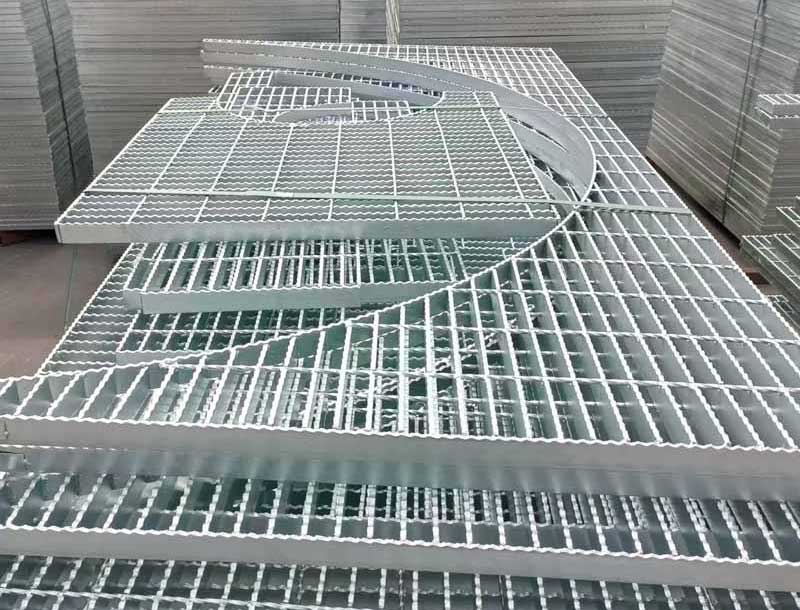
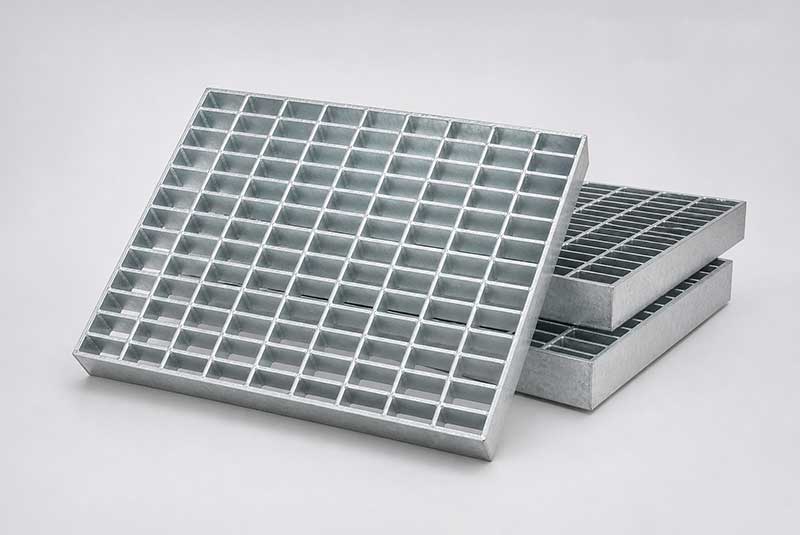
Welded steel bar grating
Welded steel bar grating is produced by joining cross bars to bearing bars at fixed intervals. The welded intersections create a rigid panel that performs consistently under repeated industrial use.
This type is commonly used for platforms, walkways, equipment access areas, mezzanines, and maintenance floors. It is valued for structural stability, efficient fabrication, and suitability for standardized or custom panel layouts.
Press-locked steel bar grating
Press-locked grating is manufactured by mechanically locking cross bars into notched or prepared bearing bars. It often has a clean, uniform appearance and can be produced with controlled spacing patterns.
It may be selected for industrial, architectural, ventilation, screening, or access applications where appearance and dimensional consistency are both important.
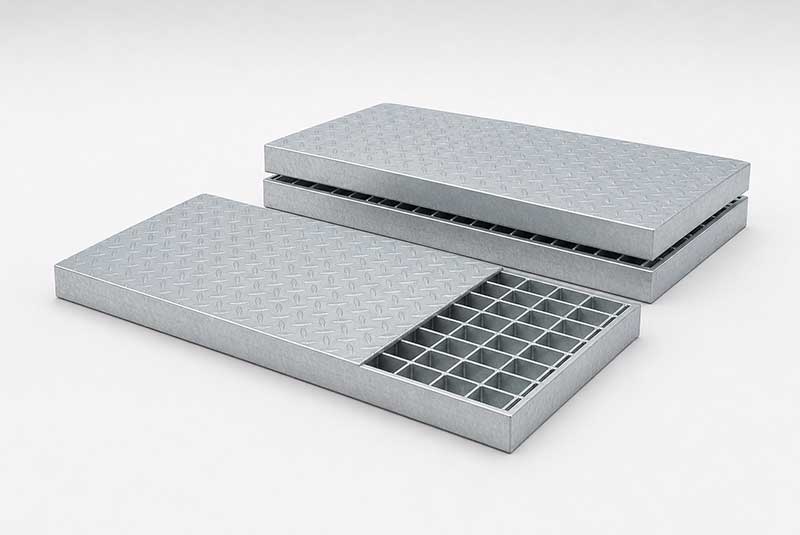
Plain steel bar grating
Plain grating uses bearing bars with smooth upper surfaces. It is suitable for many dry industrial areas, general walkways, access platforms, and locations where additional surface traction is not required.
Its simple profile is easy to inspect and maintain. However, environmental conditions should always be reviewed before choosing a plain surface.
Serrated steel bar grating
Serrated grating has notches or teeth along the upper surface of the bearing bars. These features increase contact points between the walking surface and footwear.
It is commonly considered for areas exposed to water, oil, mud, process residue, or changing weather conditions. Serrations can improve traction, but they do not replace good housekeeping, drainage, inspection, or appropriate footwear.
Heavy-duty steel bar grating
Heavy-duty grating uses larger or more closely spaced bearing bars to support demanding loads. It may be required in areas exposed to vehicles, material-handling equipment, heavy machinery, or concentrated wheel loads.
The designation “heavy duty” should not be used without supporting calculations. Load type, wheel contact area, impact, fatigue, support conditions, and deflection limits all need to be evaluated.
How Steel Bar Grating Load Capacity Is Determined
Bearing-bar dimensions
The size of the bearing bar is one of the main factors controlling load resistance. Deeper bars generally provide greater bending strength over a given span.
Thickness also matters, especially for concentrated loading, durability, and local stress. However, bar depth, thickness, and material strength must be assessed together.
Bearing-bar spacing
Closer spacing places more bearing bars beneath the applied load. This can improve load distribution, reduce the size of surface openings, and provide better support for narrow wheels or small contact areas.
Wider spacing may reduce material weight and increase open area, but it may not suit every pedestrian or equipment application.
Clear span
Clear span is the unsupported distance between structural supports. As the span increases, bending stress and deflection generally increase.
A panel that performs well over a short span may be unsuitable over a longer one, even when the bearing-bar dimensions remain unchanged. The actual support layout must therefore be confirmed before fabrication.
Uniform and concentrated loads
A uniformly distributed load spreads force across a wider area. A concentrated load applies force to a smaller contact point.
These loading conditions should not be treated as equivalent. Wheels, equipment legs, carts, and machinery supports can create local stresses that require more detailed evaluation than normal pedestrian loading.
Deflection
A panel may resist structural failure but still deflect more than the project allows. Excessive movement can affect walking comfort, equipment stability, fastening performance, and user confidence.
Good selection therefore considers both strength and serviceability.
Typical Applications of Steel Bar Grating
Industrial platforms
Steel bar grating is widely used for elevated work platforms because it combines load performance with an open, relatively lightweight structure.
The openings allow liquids, dust, and small debris to pass through rather than collecting on the working surface. This can simplify cleaning and reduce standing water when the platform is properly designed.
Walkways and catwalks
Maintenance walkways often need to provide safe access around machinery, tanks, processing equipment, conveyors, and utility systems.
Steel bar grating can be fabricated into straight, curved, segmented, or irregular panels to match structural layouts. Cutouts can also be included around pipes, supports, and equipment connections.
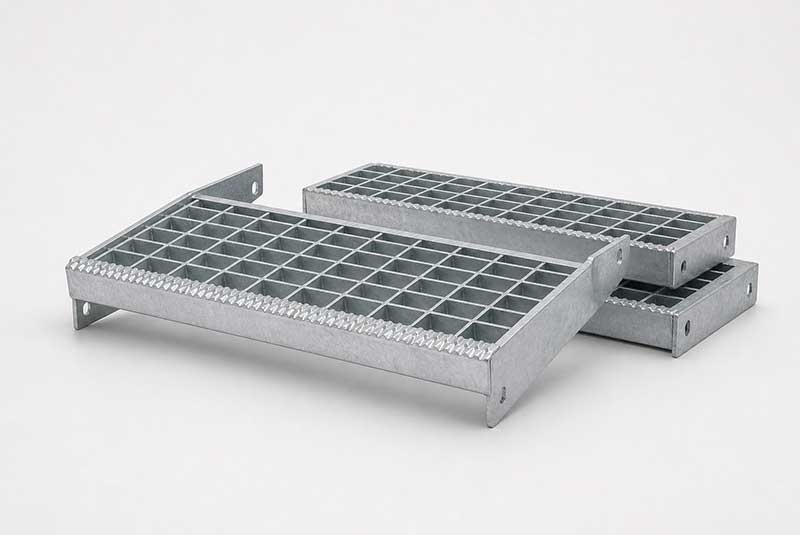
Stair treads
Grating stair treads use the same bearing-bar principle in a narrower component. They may include side plates, nosing, fastening holes, and serrated surfaces.
The tread depth, support arrangement, nosing design, and surface profile should match the intended access conditions.
Trench and drainage covers
The open structure makes steel bar grating suitable for channels, drains, pits, and service trenches. Water and small debris can pass through while the panel provides access across the opening.
For removable covers, lifting requirements and fastening methods should be considered. Panels should also be designed to prevent unwanted movement during use.
Equipment access areas
Steel bar grating can provide access around pumps, valves, filters, production lines, and mechanical installations.
Custom fabrication enables panels to fit around equipment bases and pipe penetrations without relying on uncontrolled site cutting.
Surface Treatment and Long-Term Durability
Hot-dip galvanizing
Hot-dip galvanizing protects steel by forming a zinc coating over the surface. During the galvanization process, zinc provides both a physical barrier and sacrificial protection to the underlying steel.
The effectiveness and service life of the coating depend on factors such as coating thickness, exposure conditions, drainage, contamination, mechanical damage, and maintenance practices.
Galvanizing improves corrosion resistance, but it does not make steel immune to every environment. Chemical exposure, trapped moisture, poor detailing, and damaged surfaces still require consideration.
Uncoated carbon steel
Uncoated steel may be suitable for controlled indoor environments or for projects in which another coating system will be applied after fabrication.
Its use requires careful assessment of humidity, condensation, cleaning procedures, and expected exposure.
Stainless steel
Stainless steel grating may be considered where corrosion resistance, sanitation, chemical exposure, or cleaning performance is especially important.
The selected alloy should match the service environment. The term stainless steel covers multiple grades with different mechanical and corrosion-resistance properties.
Coating selection
Surface treatment should be chosen after reviewing:
- Moisture exposure
- Chemical contact
- Cleaning methods
- Temperature
- Abrasion
- Installation environment
- Required appearance
- Expected maintenance intervals
How to Choose the Right Steel Bar Grating
Define the load condition
Start by identifying who or what will use the grating. Pedestrian access, maintenance carts, stored materials, machinery, and vehicle traffic create different load conditions.
The maximum load should not be assumed from general use alone. Concentrated loads, impact, vibration, and occasional maintenance activities may control the specification.
Confirm the span
Measure the clear distance between supporting members. Do not use the overall panel length as a substitute for the structural span.
The bearing bars must run across this support distance. Installing the panel with cross bars spanning between supports can significantly reduce load performance.
Select appropriate spacing
Spacing should suit the load, walking conditions, drainage requirements, wheel sizes, and risk of small objects passing through the surface.
Applications involving carts, narrow wheels, or small equipment components may require closer spacing than ordinary pedestrian platforms.
Evaluate the environment
Review whether the grating will be exposed to water, oil, chemicals, cleaning agents, outdoor conditions, or abrasive materials.
These conditions influence surface profile, material selection, coating, fastening, and inspection frequency.
Plan openings before fabrication
Pipe penetrations, columns, valves, equipment bases, and access hatches should be shown on project drawings whenever possible.
Factory-planned cutouts usually provide better edge finishing, fit, reinforcement, and coating continuity than uncontrolled modifications after delivery.
Provide complete project information
A useful steel bar grating request should include:
- Panel dimensions
- Clear span
- Load conditions
- Bearing-bar direction
- Support details
- Surface type
- Surface treatment
- Cutouts and openings
- Fastening requirements
- Relevant drawings
Senfa Grating’s custom fabrication support can be used to coordinate project drawings, dimensions, applications, and technical requirements before production.
Common Steel Bar Grating Selection Mistakes
Treating every grating panel as identical
Two panels with similar outside dimensions may have very different load performance. Bearing-bar size, spacing, material, and span must be considered.
Confusing panel length with bearing-bar direction
The longest side of a panel is not automatically the load-bearing direction. Bearing bars must be identified from the grid construction and installed across the structural supports.
Ignoring concentrated loads
A platform designed only for distributed pedestrian loading may not be suitable for equipment feet, wheels, carts, or temporary machinery.
Selecting serrations without reviewing the environment
Serrated surfaces can improve traction, but the complete safety system should also address drainage, cleaning, lighting, handrails, footwear, and maintenance.
Allowing excessive field cutting
Site cutting can remove banding, expose untreated steel, reduce local strength, and create poorly finished openings. Planned fabrication is generally more reliable.
Using insufficient fastening
Unsecured panels may shift, lift, vibrate, or create uneven joints. Fasteners should suit the support structure, loading, removal requirements, and operating environment.
Installation and Inspection Considerations
Support conditions
Grating should sit evenly on its supports with sufficient bearing area. Twisted, damaged, or misaligned supports can produce uneven loading and panel movement.
Panel orientation
Bearing bars must span from support to support. Cross bars are not intended to replace the primary structural function of the bearing bars.
Fastening
Clips, bolts, welding, or other fixing systems may be used depending on the project. Removable panels generally require mechanical fasteners that permit inspection and maintenance access.
Panel joints
Adjacent panels should be aligned to prevent raised edges, excessive gaps, and unstable transitions. Joint locations should also account for support positions.
Routine inspection
Inspection frequency should reflect operating conditions. Areas exposed to heavy traffic, vibration, corrosion, impact, or frequent removal may need closer monitoring.
Typical inspection points include:
- Corrosion or coating damage
- Loose or missing fasteners
- Cracked welds
- Bent bearing bars
- Excessive movement
- Damaged banding
- Enlarged openings
- Unsupported cut sections
- Uneven panel joints
Future Development of Steel Bar Grating
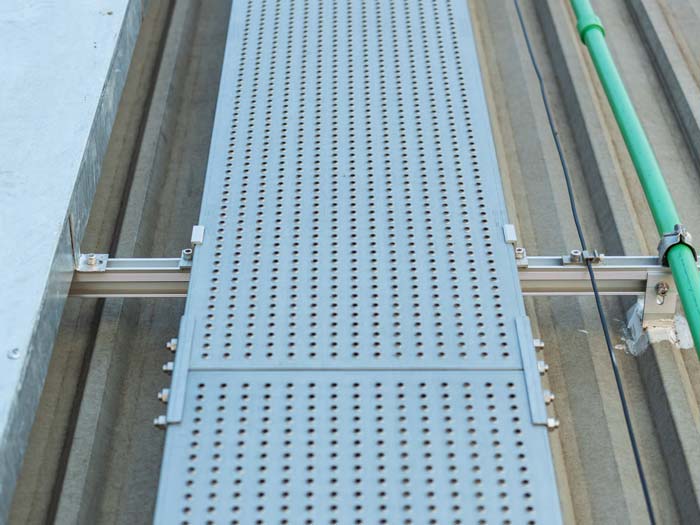
Steel bar grating development is increasingly influenced by digital design, project-specific fabrication, safety expectations, and more efficient material use.
Detailed three-dimensional models and coordinated drawings can help manufacturers identify openings, panel boundaries, support locations, and installation sequences before production begins.
Improved fabrication planning can also reduce field cutting and simplify panel identification. Clearly marked panels, coordinated layouts, and accurate cutouts support faster installation and more reliable fit.
Another important direction is performance-based selection. Rather than choosing grating only from a standard size list, project teams are increasingly evaluating actual load paths, working conditions, maintenance needs, and lifecycle performance.
Conclusion
Steel grating is the broader category, while steel bar grating is a specific load-bearing grid made from parallel bearing bars connected by cross bars.
The practical difference becomes clear during engineering and procurement. Steel bar grating can be specified according to load, span, spacing, material, surface profile, coating, panel shape, and installation requirements.
For a reliable result, you should confirm the bearing-bar direction, clear span, expected loads, environmental exposure, fastening method, and required openings before production. A complete specification reduces ambiguity and helps ensure that the finished system performs as intended.
FAQ
What is the main difference between steel grating and steel bar grating?
Steel grating is a broad product category covering open steel grid structures. Steel bar grating is a specific design made from parallel bearing bars connected by cross bars, with performance determined by bar size, spacing, material, support span, and load conditions.
How is steel bar grating load capacity calculated?
Load capacity is assessed using bearing-bar depth and thickness, bar spacing, material properties, clear span, support conditions, and load type. Concentrated wheel or equipment loads must be evaluated differently from uniformly distributed pedestrian loads.
Which direction should steel bar grating bearing bars run?
Bearing bars should run between the structural supports because they carry the primary load. Cross bars hold the grid together but are not normally designed to span the opening. Incorrect orientation can substantially reduce the panel’s effective load capacity.
Is serrated steel bar grating always better than plain grating?
Not always. Serrated grating can improve traction in wet, oily, or contaminated areas, while plain grating may be suitable for dry, controlled environments. Selection should consider drainage, cleaning, footwear, maintenance, and overall workplace safety.
Can steel bar grating be customized for irregular platforms?
Yes. Panels can be fabricated with project-specific dimensions, curved edges, pipe openings, equipment cutouts, banded borders, stair-tread details, and fastening provisions. Accurate drawings help preserve structural performance and reduce unnecessary field modifications.